

A restaurant can introduce a country to its customers one meal at a time. In a foreign city, a familiar dish can offer expatriates a taste of home while introducing local diners to another culinary tradition.
For Pakistani restaurant owners, Pakistani restaurants in China serve both purposes. Beyond preparing meals, these businesses navigate ingredient sourcing, customer preferences and competition while introducing Chinese diners to the flavours of Pakistani cuisine.
From Harbin in northeastern China to Beijing, Pakistani restaurants illustrate how food can create everyday opportunities for cultural exchange between Pakistan and China.
Pakistani Restaurants in China: From a Pakistani Kitchen to a Chinese City
In Harbin, the capital of Heilongjiang Province in northeastern China, Pakistani entrepreneur Muhammad Atif established Man-O-Salwa in 2019 after completing his doctoral studies at a local university.
According to a report by the Associated Press of Pakistan (APP), Atif wanted to introduce authentic Pakistani food to Chinese customers. The restaurant employed Pakistani chefs and staff, while manager Muhammad Usama helped diners navigate the menu.
The business faced difficulties during the COVID-19 pandemic but continued operating. Its management also used short-video platforms to showcase dishes and collect customer feedback.
These experiences highlight a practical challenge for Pakistani restaurants in China: introducing a cuisine requires more than preparing traditional dishes. Customers must discover the restaurant, understand its menu and find reasons to return.
Man-O-Salwa combined traditional cooking with digital promotion. Its staff introduced dishes such as curry chicken and traditional milk tea while seeking to preserve Pakistani flavours through its ingredients and kitchen team.
The APP report also quoted a local diner, Ai Mingzhe, who said that trying the restaurant’s food had increased his interest in Pakistan.
This response illustrates one potential benefit of culinary exchange. A meal can offer an introduction to a culture that customers might otherwise encounter through news, education or official events.
Pakistani Cuisine in Beijing: A Growing Food Scene
A similar development has taken place in Beijing, where Pakistani restaurants serve members of the Pakistani community alongside customers interested in South Asian cuisine.
In July 2025, the Associated Press of Pakistan reported on the opening of Zafran, a Pakistani restaurant inaugurated by Pakistan’s then ambassador to China, Khalil Hashmi.
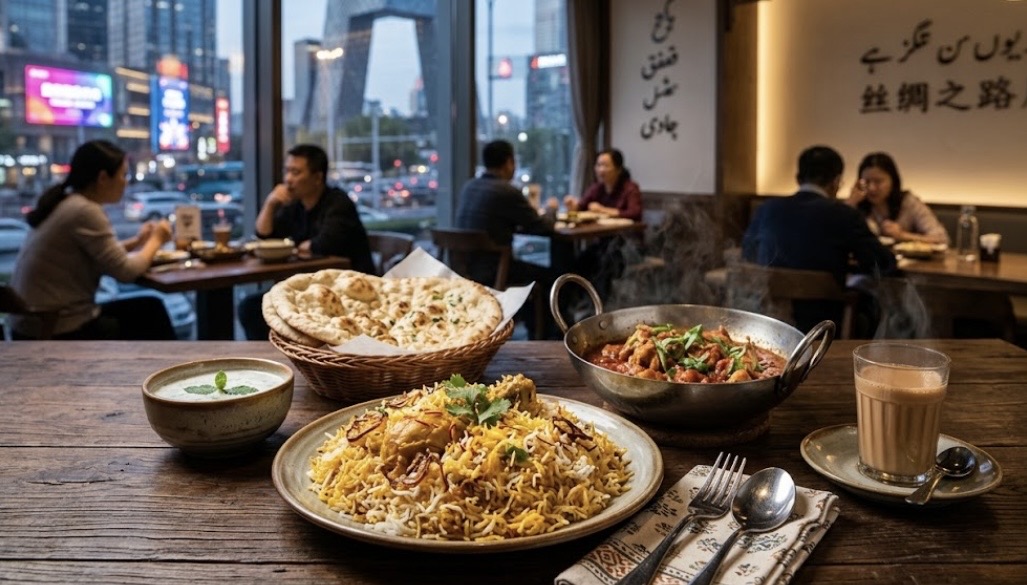
The report described a Beijing food scene in which Pakistani dishes, including biryani, karahi, naan, chapli kebabs, tikka and lassi, were becoming more visible.
These restaurants serve different audiences. Pakistani students and residents may seek familiar meals, while Chinese customers may visit to explore a new cuisine. Business representatives and other visitors can also encounter Pakistani food during professional meetings and social gatherings.
Each audience may approach the dining experience differently. Someone familiar with Pakistani cooking may judge a dish against memories of home, while a first-time diner may want to understand its ingredients, preparation methods or level of spice.
For restaurant staff, explaining the menu can therefore become an important part of introducing Pakistani cuisine to Chinese customers.
Authenticity and the Challenges of Running a Restaurant Abroad
Maintaining a recognisable culinary identity can be challenging when a restaurant operates far from its country of origin.
Ingredients may need to be sourced from different suppliers, and certain products may be difficult to obtain. Imported ingredients can also affect operating costs and availability. Restaurant owners must balance traditional recipes with food-safety requirements, local regulations, staffing expenses and customer expectations.
Man-O-Salwa offers a documented example of how a business has approached these challenges. According to APP, the restaurant employed Pakistani chefs and sourced many ingredients directly from Pakistan to maintain its flavours.
However, ingredient sourcing is only one part of preserving authenticity. Cooking techniques, staff experience, consistency and menu design also influence the final dining experience.
Restaurant owners must decide how to introduce unfamiliar dishes, which ingredients require explanation and whether their menus should prioritise traditional recipes or offer a broader selection to appeal to different customers.
These decisions have both commercial and cultural implications. A restaurant needs customers who enjoy its food enough to return, but it also needs a distinctive identity that separates it from competing dining options.
The available reporting does not establish how Pakistani restaurants across China approach these questions collectively. Individual businesses may face different circumstances depending on their locations, customer bases and financial resources.
How Digital Platforms Help Pakistani Restaurants Reach New Customers
Online reviews and short videos have become useful promotional tools for restaurants seeking to attract new customers. For cuisines that may be unfamiliar to local audiences, visual content can demonstrate how dishes look, how they are prepared and how they are served.
Man-O-Salwa’s use of short-video platforms, as documented by APP, illustrates how digital promotion can support a Pakistani food business in China.
A video featuring a sizzling dish, freshly prepared naan or a traditional Pakistani drink can introduce potential customers to a restaurant’s offerings. Online reviews can also help diners decide whether to visit.
However, digital visibility does not necessarily translate into long-term commercial success. Restaurants must consistently deliver quality food, reliable service and value for money. Online attention may encourage a first visit, but repeat business depends on the overall customer experience.
For Pakistani restaurant owners in China, the challenge is not simply to attract attention to their cuisine. It is to turn initial curiosity into a sustainable customer base.
Food as a Bridge Between Pakistan and China
Pakistan-China cultural exchange is often discussed through student programmes, festivals, official visits and educational cooperation. Restaurants provide another setting for interaction, allowing people to encounter a different culture through everyday experiences rather than formal events.
A Chinese diner trying Pakistani food may ask about an ingredient, a cooking technique or the origin of a dish. A restaurant employee may explain its preparation or recommend a meal commonly enjoyed in Pakistani households.
Such conversations can create opportunities for cultural learning, although their impact varies from one customer to another.
Food should not be treated as a substitute for deeper engagement between societies. A restaurant cannot, by itself, represent the full diversity of Pakistan’s regional cuisines or explain the complexity of Pakistani culture.
Nevertheless, it can provide a tangible introduction.
Pakistani cuisine is diverse, shaped by regional ingredients, cooking techniques and culinary traditions. Food associated with Punjab, Sindh, Khyber Pakhtunkhwa, Balochistan and other communities reflects different influences and preferences.
Restaurants operating abroad must decide which parts of this diversity to present to their customers. Some may focus on widely recognised dishes, while others may introduce regional specialities.
Examining the menus of Pakistani restaurants in different Chinese cities could offer further insight into how these businesses represent Pakistan’s culinary diversity.
Beyond Biryani: The Future of Pakistani Food Businesses in China
The experiences of Man-O-Salwa in Harbin and Zafran in Beijing suggest that Pakistani cuisine has a visible presence in parts of China’s urban food market. They also demonstrate how restaurant businesses can combine commercial activity with opportunities for cultural introduction.
However, their long-term prospects depend on more than their symbolic value. Operating costs, customer demand, competition, staffing and the ability to maintain consistent standards all influence business sustainability.
A clearer understanding of Pakistan’s restaurant sector in China would require interviews with restaurant owners, chefs, suppliers and customers across different cities. Evidence about business performance and consumer preferences would also help establish whether interest in Pakistani cuisine is translating into sustained commercial growth.
For now, these examples illustrate how cultural exchange can begin with an ordinary dining experience. A customer opens a menu, asks what a dish contains and decides to try something unfamiliar.
For Pakistani restaurant owners in China, that first meal can represent both a business transaction and an invitation to discover another country’s food traditions.