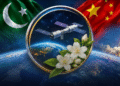



Pakistan is preparing for a historic step in its space programme as its first astronaut gets ready to travel to China’s Tiangong space station aboard the Shenzhou-24 mission.
The Pakistani astronaut is expected to spend around one week in orbit, participating in scientific research and experiments in the microgravity environment before returning to Earth aboard the Shenzhou-23 spacecraft, according to reports.
The mission will make the selected Pakistani candidate the first foreign national to visit China’s space station and the first international participant in China’s crewed spaceflight programme.
When Will Pakistan’s First Astronaut Travel to Space?
The Shenzhou-24 mission is expected to launch in the coming days from the Jiuquan Satellite Launch Centre in northwestern China.
Pakistan’s Minister for Planning, Development and Special Initiatives, Ahsan Iqbal, has arrived in Beijing to attend the astronaut’s departure ceremony. He is also scheduled to meet the two Pakistani candidates who have completed their training in China.
Although Iqbal previously indicated November 25, 2026, as the expected flight date, China’s Manned Space Agency (CMSA) has not officially confirmed the launch schedule. The agency has said the mission will take place at an appropriate time following final preparations.
Who Will Represent Pakistan in Space?
Two Pakistani astronaut candidates, Muhammad Zeeshan Ali and Khurram Daud, have completed specialised training in China.
They were selected through a three-stage assessment process under the space cooperation agreement signed between Pakistan and China in February 2025.
One candidate will join the Shenzhou-24 mission as a payload specialist, while the other will serve as the backup astronaut. The final selection will be made before the flight.
The selected astronaut will participate in scientific activities aboard Tiangong rather than serve as a primary spacecraft pilot or station commander.
What Will Pakistan’s Astronaut Do at the Space Station?
The Pakistani astronaut will conduct scientific research in the microgravity environment aboard Tiangong.
According to details shared by Pakistan’s Space and Upper Atmosphere Research Commission (SUPARCO), four Pakistani biotechnology experiments were selected from more than 300 research proposals submitted by universities and research institutions.
The experiments are designed to explore scientific questions linked to food security and climate change. They were developed and tested in Pakistani laboratories before undergoing technical assessment by Chinese experts.
The research will provide Pakistani scientists with an opportunity to study how biological processes behave in microgravity and explore potential applications for future scientific and technological development.
When Will the Pakistani Astronaut Return to Earth?
The astronaut is expected to return after approximately one week in orbit.
Rather than returning aboard the Shenzhou-24 spacecraft, the Pakistani payload specialist will travel back to Earth aboard Shenzhou-23, which is already docked with China’s Tiangong space station.
This arrangement will allow the visiting astronaut to complete a short-duration mission while returning with the departing crew of the Chinese space station.
The mission will therefore mark an important milestone in China’s international space cooperation as well as Pakistan’s participation in human spaceflight.
A New Chapter in Pakistan-China Space Cooperation
Pakistan’s participation in Shenzhou-24 represents a major expansion of scientific cooperation between Islamabad and Beijing.
The two countries signed their astronaut cooperation agreement in February 2025, establishing a framework for selecting and training Pakistani candidates for missions to China’s space station.
Their partnership already includes satellite development, space technology and scientific research. The upcoming human spaceflight will take this cooperation into a new phase by giving a Pakistani astronaut the opportunity to conduct research in orbit.
For Pakistan, the mission is expected to create new opportunities for scientific learning, biotechnology research and the development of future space capabilities.
The approximately week-long visit will be a historic first for the country and an important step towards greater participation in international space exploration.
Read More Articles:
Ahsan Iqbal in Beijing for Pakistan’s First Astronaut Mission
Pakistan and China Explore Advanced Semiconductor Research
China’s Shenzhou-24 Mission to Carry First Pakistani Astronaut to Space Station