
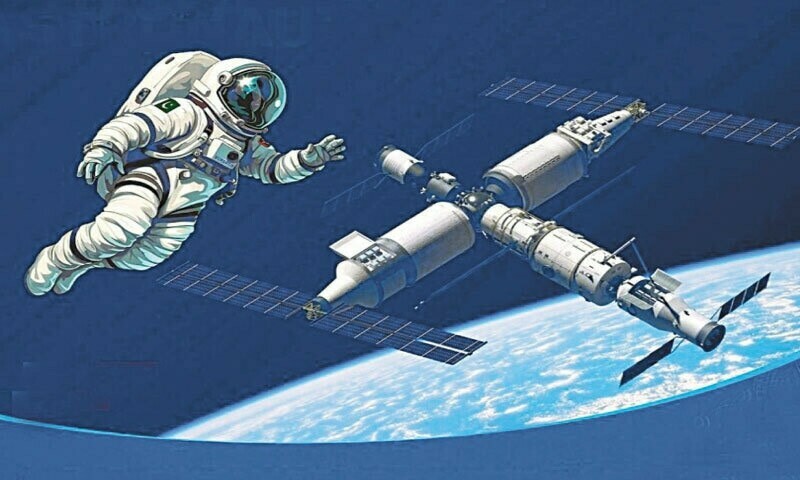
Pakistan is set to achieve a historic milestone in space exploration as one of its astronauts prepares to join China’s Shenzhou-24 crewed spaceflight mission.
The China Manned Space Agency (CMSA) announced on November 7 that a Pakistani astronaut will participate in the mission as a payload specialist, becoming the first foreign national to visit China’s Tiangong space station.
The astronaut will undertake a short-duration orbital mission alongside Chinese crew members before returning to Earth aboard the Shenzhou-23 spacecraft, according to the agency.
Although CMSA has not identified the selected astronaut or announced an exact launch date, the mission is expected to take place before the end of 2026.
The development marks the first joint spaceflight involving Chinese and foreign astronauts in the history of China’s crewed space programme. It also represents a major step forward in Pakistan-China scientific and technological cooperation.
Muhammad Zeeshan Ali and Khurram Daud Selected for Space Training
The upcoming mission follows a bilateral agreement signed by Pakistan and China in February 2025 to select and train Pakistani astronauts for missions aboard the Chinese space station.
Pakistan’s Space and Upper Atmosphere Research Commission (SUPARCO) and China’s space authorities established the cooperation framework to prepare Pakistani candidates for human spaceflight.
Following three stages of selection and assessment, two Pakistani pilots, Muhammad Zeeshan Ali and Khurram Daud, were selected in April 2026 as the country’s first astronaut candidates under the programme.
Both candidates travelled to China and joined the Astronaut Center of China in Beijing for specialised training.
After completing their training and passing the required evaluations, one candidate will participate in the Shenzhou-24 mission as a payload specialist, while the other will remain available as the backup astronaut.
China has not yet announced which candidate will undertake the historic flight.
Pakistani Astronauts Undergo Intensive Training in China
The two candidates have undergone specialised preparation to develop the physical fitness, technical knowledge and operational skills required for human spaceflight.
Their training includes intensive Mandarin language instruction, spacecraft operations, microgravity adaptation and exercises designed to prepare them for the physical pressures of launch and orbital travel.
The programme also involves learning spacecraft systems, understanding mission procedures and developing the ability to perform technical duties in a weightless environment.
Mandarin instruction is particularly important because the Pakistani astronaut will work alongside Chinese crew members and communicate using the language during the mission.
According to reporting by Reuters, the candidates have also undertaken centrifuge exercises to prepare for the high gravitational forces experienced during spacecraft launch.
The training is designed to ensure that the selected astronaut can safely perform scientific and technical responsibilities aboard Tiangong.
Pakistani Astronaut to Conduct Scientific Experiments in Orbit
The Pakistani astronaut will serve as a payload specialist, meaning the primary responsibility will involve conducting scientific experiments rather than operating or commanding the spacecraft.
Pakistan has identified scientific research as a central objective of its participation in China’s space station programme.
According to Reuters, Pakistani researchers submitted more than 300 experimental proposals for consideration. Four biotechnology experiments were selected for the upcoming mission, with research focusing on food security and climate change.
The experiments were developed through Pakistani research institutions and laboratories before undergoing technical assessment by Chinese engineers.
Research in microgravity can help scientists investigate biological processes and material behaviour under conditions that are difficult to reproduce on Earth.
Potential research areas associated with Pakistan’s astronaut programme include:
- Biotechnology and life sciences
- Food security and agricultural research
- Climate change-related studies
- Microgravity research
- Materials science
- Aerospace and applied physics
The final scientific activities assigned to the astronaut will depend on the approved mission programme.
Tiangong Space Station Opens a New Opportunity for Pakistan
China’s Tiangong space station, whose name means Heavenly Palace, is an independently developed orbital research facility designed to support scientific experiments, technological development and long-duration human spaceflight.
The station consists of three main modules: Tianhe, Wentian and Mengtian.
Tianhe serves as the central module, providing living quarters and mission-control facilities for astronauts. Wentian and Mengtian provide additional laboratories and research equipment.
The facility supports experiments in several scientific fields, including space biology, materials science, fluid physics, radiation studies and space technology.
Pakistan’s participation will introduce the first foreign astronaut into China’s crewed space programme and expand the international dimension of its space station operations.
For Pakistani scientists, the mission will also provide an opportunity to participate directly in orbital research and gain experience through cooperation with Chinese space institutions.
Pakistan-China Space Cooperation Expands Beyond Human Spaceflight
The astronaut mission represents a new phase in the broader Pakistan-China partnership in space science and technology.
The two countries have already cooperated in satellite development, satellite launches, remote sensing and other space-related activities.
China has supported the launch of several Pakistani satellites, while SUPARCO continues to develop the country’s capabilities in satellite technology and scientific research.
The February 2025 astronaut agreement extended this cooperation into human spaceflight, giving Pakistan an opportunity to send one of its citizens aboard China’s independently operated space station.
The partnership also includes cooperation in lunar exploration. Reuters reported in September that a Pakistani-developed lunar rover is being prepared for China’s Chang’e-8 mission, currently planned for around 2028.
The rover is expected to use artificial intelligence and imaging technology to navigate the lunar surface and identify obstacles.
These initiatives demonstrate the expanding scope of bilateral cooperation, extending from satellite technology to astronaut training, scientific experiments and future lunar exploration.
Historic Mission Marks New Chapter for Pakistan’s Space Programme
The Shenzhou-24 mission will provide Pakistan with its first direct participation in an international crewed spaceflight programme.
Although the mission will use Chinese spacecraft, launch facilities, training infrastructure and technical support, it will give Pakistani astronaut candidates valuable experience in human spaceflight.
The successful participation of a Pakistani astronaut could also create opportunities for further scientific collaboration, research partnerships and advanced technical training.
China’s invitation reflects its growing international engagement through its space programme, while Pakistan gains access to specialised facilities and expertise that would otherwise be difficult to develop independently.
As preparations continue, the announcement of the selected astronaut and the final mission schedule will mark the next important steps towards Pakistan’s historic journey to the Tiangong space station.
Read More Articles:
KP Invites Chinese Investors to Explore Mineral Sector
Diamer-Basha Dam Hires 10 Pakistani Graduates
Pakistan and Xinjiang Explore Joint Investment Opportunities