

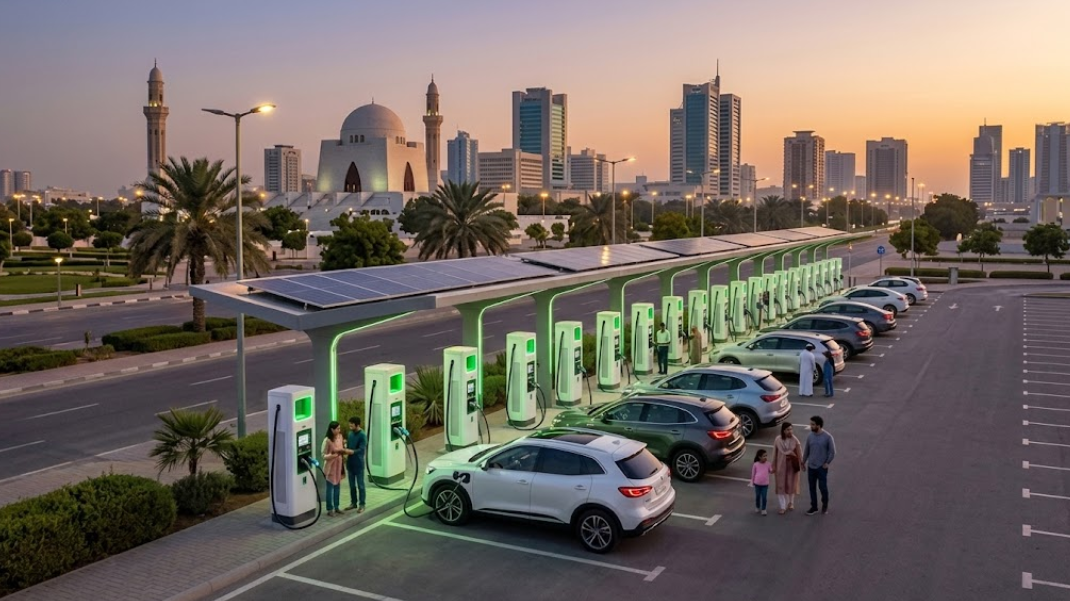
Pakistan plans to establish around 3,000 public electric vehicle (EV) charging stations nationwide by 2030 under the government’s New Energy Vehicle (NEV) Policy 2025–30.
In a written reply to the National Assembly, the Ministry of Industries and Production said the policy includes an initial phase of 40 fast-charging stations along motorways and selected sections of the National Highway (N-5).
The government also plans to install charging points at intervals of approximately 50 kilometres along major highways to support the growing use of electric vehicles.
The ministry provided the information in response to a question from lawmaker Malik Shakir Bashir Awan.
Government Plans Multiple Charging Options
Under the NEV policy, fuel stations will be encouraged to install EV charging units. The government also plans to expand fast-charging facilities alongside Level 2 and Level 1 charging infrastructure.
Battery-swapping stations are another part of the plan, particularly for electric two-wheelers and three-wheelers. These facilities would allow users to replace depleted batteries with charged ones instead of waiting for recharging.
Expanding these options could make electric vehicles more practical for different types of users and journeys.
Incentives to Attract Private Investment
The government plans to encourage private-sector participation in developing the charging network.
According to the ministry, incentives include a dedicated commercial electricity tariff for charging stations and faster electricity connections. Public-private partnerships and viability gap funding arrangements are also included in the policy.
These measures aim to encourage investment in charging infrastructure and support the expansion of electric mobility across Pakistan.
Pakistan Plans EV Battery Recycling Framework
The policy also addresses the management of end-of-life electric vehicle batteries, particularly lithium-ion batteries.
The ministry said work was under way to develop a regulatory framework covering battery collection, transportation, reuse, dismantling and recycling.
Plans also include establishing a nationwide network of battery collection and recycling facilities. These measures are intended to support safer battery management and reduce the environmental risks associated with improper disposal.
Infrastructure Key to Electric Mobility Growth
Expanding public charging facilities will be an important part of Pakistan’s transition towards electric transport. Reliable charging access, suitable electricity connections and effective battery management will help support the wider use of electric vehicles.
The target of 3,000 public charging stations by 2030 sets out the government’s planned direction under the NEV Policy 2025–30. Achieving it will depend on implementation, investment and the development of supporting infrastructure.
Read More Articles:
188 Graduates Receive Degrees at RLMC Convocation 2026