

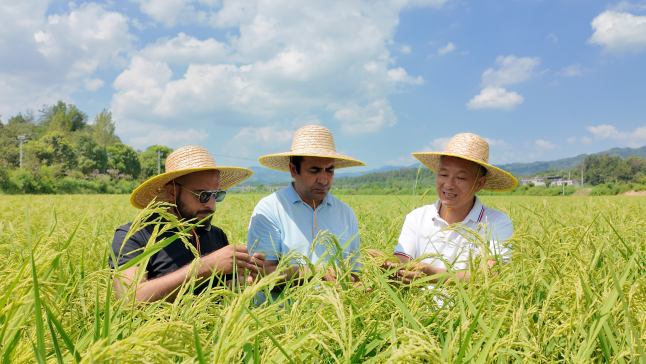
Chinese-developed Honglian hybrid rice is gaining momentum in Pakistan as researchers from both countries expand cooperation in agricultural science and food security.
The progress was highlighted at the 2nd International Symposium on Improved-Variety Breeding of Honglian Type Hybrid Rice, held in Luotian, Hubei, from August 8 to 10.
The event brought together Chinese and Pakistani agricultural experts. They discussed joint research and the growing economic benefits of Honglian hybrid rice for Pakistani farmers.
Honglian Rice Shows Strong Potential
Honglian hybrid rice was developed by the late academician Zhu Yingguo of Wuhan University. It is one of the world’s three major cytoplasmic male sterility systems.
The other two systems are China’s Wild Abortive type and Japan’s BT type.
Honglian rice offers several important genetic advantages. These include heat tolerance, wide adaptability, and high grain quality.
As a result, farmers now grow the variety across parts of South China and several Belt and Road partner countries. These include Pakistan, Malaysia, and the Philippines.
Hybrid Rice Brings Economic Benefits
Qu Wenqian, Deputy Party Secretary of Wuhan University, said Honglian hybrid rice has generated more than RMB 9 billion in direct economic benefits.
These benefits have come from China and Belt and Road partner countries.
Professor Zhu Renshan of Wuhan University also highlighted the importance of the Luotian breeding base. He said the facility helps protect domestic seed security while sharing agricultural expertise with international partners.
Pakistan Has Major Growth Potential
Dr. Muhammad Ashfaq from the University of the Punjab highlighted the potential for hybrid rice expansion in Pakistan.
According to him, coarse rice accounts for about one-third of Pakistan’s rice cultivation area. Replacing some of this production with hybrid rice could significantly increase yields.
He identified Sindh, Balochistan, and southern Punjab as promising areas for further adoption.
Moreover, he said Honglian hybrid rice could raise farm output and increase farmer incomes by billions of rupees.
China-Pakistan Research Partnership
Wuhan University and the University of the Punjab established a Joint Research Center of Honglian Type Hybrid Rice in 2020.
Since then, researchers have conducted multi-location trials across Pakistan’s four major rice-growing zones.
The trials tested nine hybrid lines. One of them, HP4, achieved a major milestone after Pakistan officially registered it as PU-786 in 2025.
Following national commercial approval, farmers began commercial cultivation of the variety across Pakistan in 2026.
Rice Variety Offers Climate Resilience
PU-786 has several characteristics that could benefit Pakistani farmers.
The variety shows strong heat tolerance and resistance to pests and diseases. It also has broad adaptability to challenging farming conditions.
In particular, these traits could help farmers facing water shortages and declining soil quality.
Furthermore, wider adoption could help Pakistan improve rice productivity while strengthening domestic food security.
Stronger Agricultural Cooperation Ahead
The development of Honglian hybrid rice reflects growing agricultural cooperation between Pakistan and China.
Joint research can help Pakistan introduce improved crop varieties while building local expertise in modern plant breeding.
At the same time, higher yields could improve farmer incomes and support Pakistan’s wider agricultural economy.
With commercial cultivation now underway, researchers and farmers will continue assessing the variety’s performance across different regions.
The growing cooperation also highlights the potential for China-Pakistan agricultural partnerships to support sustainable farming, higher productivity, and long-term food security.
Read More Articles:
120 Girls Complete Healthcare Training
A Summer in Dali, Where Travelers Learn to Linger