

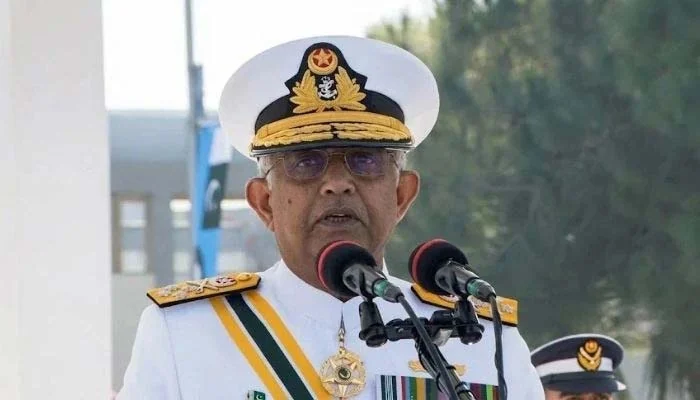
Chief of the Naval Staff Admiral Naveed Ashraf has said that advances in artificial intelligence (AI) and information technology are fundamentally transforming modern warfare, changing how military forces prepare, operate and respond to security threats.
Addressing the graduation parade at the Pakistan Air Force (PAF) Academy Asghar Khan in Risalpur on Thursday, November 19, he said conflicts were no longer limited to conventional battlefields.
The naval chief explained that modern military operations increasingly involved electronic warfare, cyberspace, outer space and the cognitive domain. He added that autonomous systems, artificial intelligence and information warfare had changed the nature of military engagements.
Modern Warfare Expanding Beyond Traditional Battlefields
Admiral Ashraf said emerging technologies were transforming military concepts, operational doctrines and organisational structures.
He highlighted how technological developments had expanded the scope of conflicts beyond traditional land, sea and air operations.
Electronic warfare, cyber operations, space-based capabilities and information campaigns have become increasingly important components of modern military strategy.
He stressed that autonomous systems and AI were also influencing how armed forces conduct operations and make decisions.
These developments, he said, required innovative approaches and continuous adaptation to meet the demands of technology-intensive warfare.
Pakistan Navy Strengthening Its Technological Capabilities
The naval chief also highlighted the Pakistan Navy’s progress in modernising its fleet and strengthening its combat capabilities across different operational domains.
He identified several developments supporting the modernisation effort, including the induction of advanced warships, Hangor-class submarines, locally developed long-range weapons and unmanned systems.
He also mentioned the establishment of the Pakistan Maritime Science and Technology Park as an important development in the country’s maritime technology sector.
Pakistan is set to induct eight Hangor-class submarines. The first submarine arrived at Karachi Port in June 2026 and conducted its maiden live weapon firing in the Arabian Sea in September.
The Navy has also conducted tests of locally developed anti-ship weapons, including an anti-ship ballistic missile and the Taimoor weapon system. These developments form part of efforts to strengthen indigenous defence production and maritime capabilities.
Naval Chief Stresses Multi-Domain Military Preparedness
Admiral Ashraf said rapidly changing geopolitical conditions were creating increasingly complex security challenges.
He stressed that armed forces needed constant vigilance, strategic planning and operational readiness to address conventional, hybrid and asymmetric threats.
He also highlighted the importance of cooperation among Pakistan’s armed services, describing the Army, Navy and Air Force as complementary forces operating across land, maritime and multi-domain environments.
Referring to the May 2025 Pakistan-India conflict, which Pakistan calls Marka-e-Haq, he praised the PAF’s performance and described its multi-domain operations and use of indigenous capabilities as significant developments. These remarks reflected his assessment of the armed forces’ operational experience and modernisation efforts.
PAF’s Professional Legacy and Future Challenges
Congratulating the graduating cadets, Admiral Ashraf described his participation in the passing-out parade as an honour.
He praised the Pakistan Air Force for its distinguished history, professional standards and operational achievements, saying its capabilities and expertise were recognised internationally.
He also recalled Quaid-e-Azam Muhammad Ali Jinnah’s emphasis on the importance of a strong air force for national defence.
The naval chief encouraged the graduating officers to uphold the PAF’s traditions and maintain professionalism, discipline and teamwork as they begin their careers.
He also reaffirmed Pakistan’s commitment to restraint, dialogue, diplomacy and regional stability, while emphasising the armed forces’ responsibility to defend the country.
Admiral Ashraf’s address highlighted how technological innovation is becoming central to military preparedness. As AI, autonomous platforms and information warfare continue to influence defence strategies, Pakistan’s armed forces are seeking to strengthen their capabilities to meet the changing requirements of modern warfare.
Read More Articles:
Xi Hosts Welcome Banquet for APEC Leaders in Shenzhen
Xi, Putin and Trump Hold Historic Shenzhen Summit
China and Pakistan Deepen Governance Cooperation Following CPC Fifth Plenum