

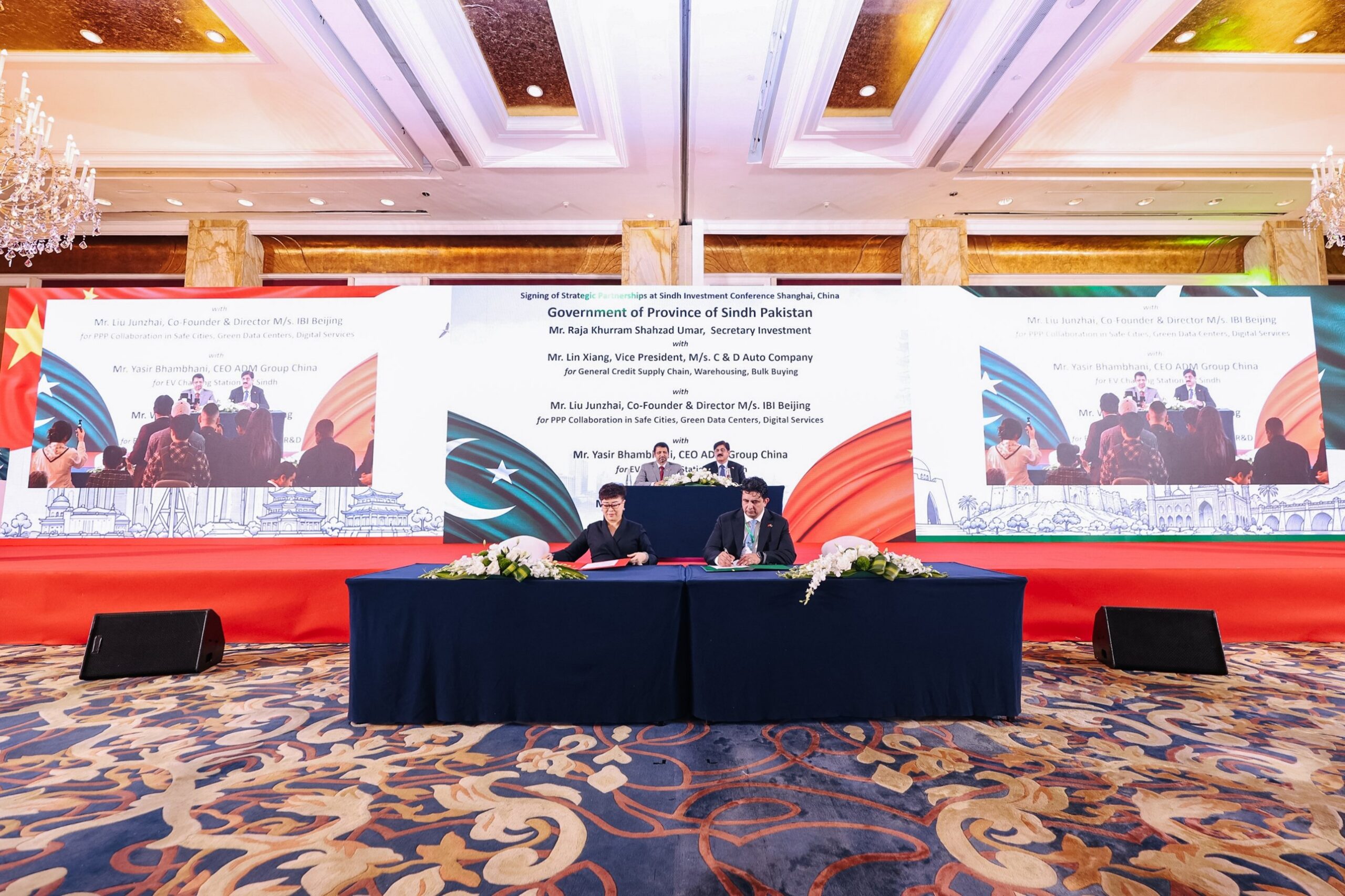
Chinese industrial e-commerce company Beijing United Information Technology (IBI) has signed a memorandum of understanding (MoU) with Pakistan’s Sindh province. The agreement aims to explore digital infrastructure and industrial technology projects.
IBI signed the agreement on October 15 during the Sindh Investment Conference in Shanghai. The company plans to explore public-private partnerships in safe-city systems, green data centres and digital services.
In addition, the agreement covers the digitalisation of enterprises, factories, industrial parks and ports across Sindh.
IBI Expands Digital Cooperation in Sindh
IBI Director and Senior Vice President Liu Junzhai signed the MoU with Sindh Investment Secretary Raja Khurram Shahzad Umar. Pakistan’s Ambassador to China, Syed Ali Asad Gilani, attended the ceremony.
The agreement expands IBI’s industrial cooperation in Pakistan to the provincial level. It also links the company’s plans with the second phase of the China-Pakistan Economic Corridor (CPEC).
CPEC Phase Two focuses on industrial and agricultural cooperation. Meanwhile, IBI plans to bring its suppliers and business partners into Sindh to explore new commercial opportunities.
Sindh Attracts Investment in Emerging Technologies
Sindh Chief Minister Syed Murad Ali Shah said the province contributes more than 27 per cent of Pakistan’s economy.
Therefore, the provincial government used the Shanghai conference to attract investment in energy, manufacturing, agriculture and emerging technologies.
According to the provincial government, the conference produced 34 memorandums and agreements. These deals reflect Sindh’s efforts to expand investment and build economic partnerships.
Sindh Plans Public-Private Partnership Framework
Syed Qasim Naveed Qamar, the chief minister’s special assistant on investment and public-private partnership, outlined the next step.
He said the provincial government would establish a mechanism to identify potential projects and assess their requirements, according to IBI’s statement.
This mechanism could help Sindh match its digital infrastructure needs with IBI’s technology and business network. However, the agreement does not confirm specific project investments or construction timelines.
Digital Projects Could Support CPEC Phase Two
IBI said the agreement also supports its cross-border industrial-belt strategy and expands its presence in South Asia.
As Pakistan and China advance CPEC Phase Two, digital services and data centres could create new opportunities for industrial modernisation in Sindh.
However, the success of these projects will depend on investment decisions, project approvals and implementation. The MoU provides a framework for cooperation, while specific projects remain subject to further planning.
Read More Articles:
Pakistan bans Taiwanese Airlines From Its Airspace
Pakistan Accelerates Lithium Exploration for Battery Industry
Pakistan-China Friendship Celebrated at Narowal Hockey Match