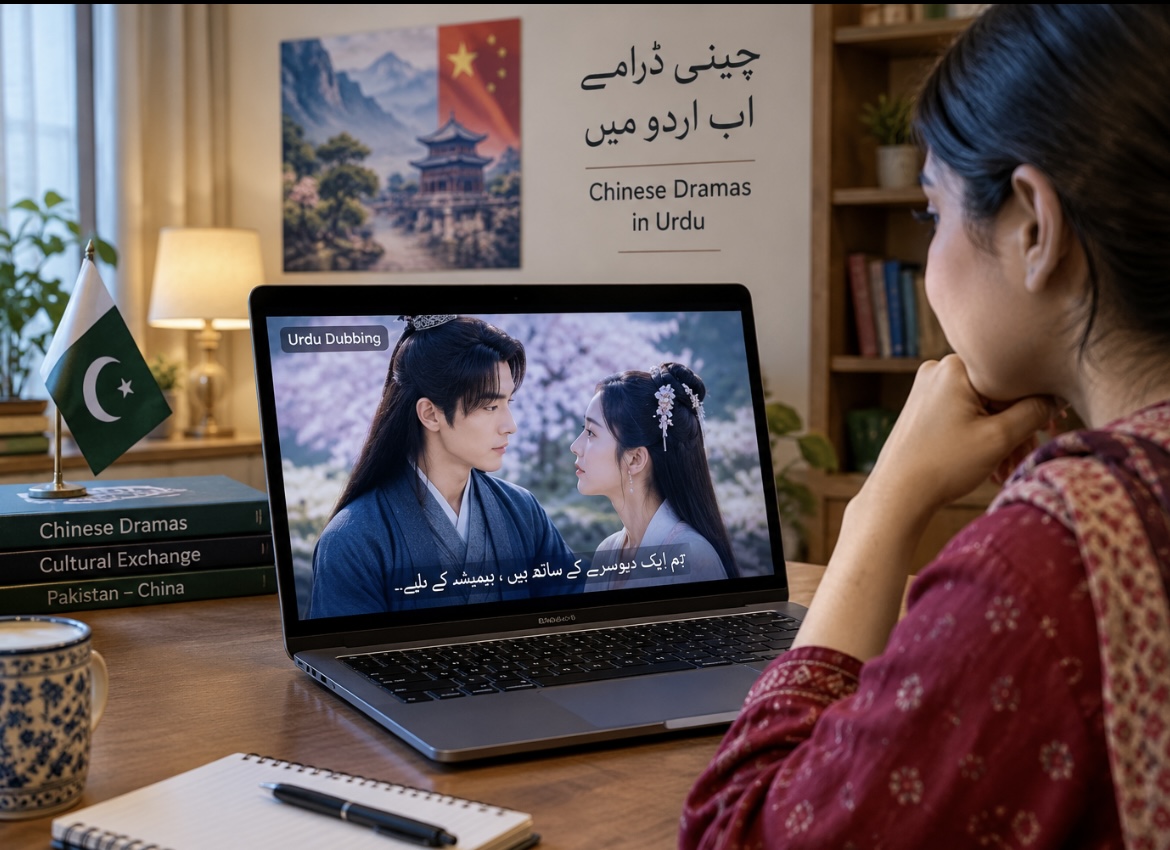
A Chinese drama can now reach a Pakistani viewer without requiring them to understand Mandarin.
This may seem like a small technical change. However, language often determines whether cultural exchange reaches a new audience or stops at the border.
In Pakistan, viewers can access Chinese dramas through Urdu and Hindi dubbing, Urdu subtitles and digital platforms. These options make Chinese stories easier to enjoy, even for people unfamiliar with the Chinese language.
The exact size of this audience remains unclear. Pakistan has no publicly available national dataset showing how many people watch Chinese dramas. Platform figures are also fragmented.
Nevertheless, several digital platforms and dubbing services demonstrate that an Urdu-language distribution network already exists.
Chinese Dramas in Urdu Are Available on Digital Platforms
Tapmad, a Pakistani streaming platform, has published catalogues of Chinese dramas available in Urdu or Hindi dubbing. These include Douluo Continent, Put Your Head on My Shoulder, Love Scenery and My Girlfriend Is an Alien.
The platform’s editorial material also discusses Urdu and Hindi versions within the wider South Asian entertainment market. This provides evidence of organised distribution, although it does not establish the size of Pakistan’s audience.
Meanwhile, CPOP HOME maintains a catalogue of Chinese dramas with Urdu subtitles. Its collection shows that Urdu-language access extends beyond occasional fan translations.
Together, these platforms illustrate how viewers can discover Chinese entertainment without relying entirely on Mandarin-language releases.
How Urdu Dubbing Makes Chinese Stories Easier to Watch
Dubbing does more than replace Mandarin dialogue with another language. It can also change how viewers experience a drama.
With subtitles, viewers must divide their attention between reading and watching. Dubbing allows them to follow conversations, expressions and plot developments without constantly looking down at the screen.
This difference matters in a market where audiences already watch dramas in Urdu, Hindi, Turkish and other languages through translated formats.
Dyar Studios, a Lahore-based dubbing operation, advertises Chinese-to-Urdu and Chinese-to-Hindi projects. Its website describes a production process involving translation, voice recording, audio mixing and quality control.
The company also advertises a large collection of dubbed dramas. However, these are company-reported figures, not independently audited industry statistics. They demonstrate the presence of a commercial dubbing ecosystem rather than the total size of Pakistan’s Chinese drama audience.
Urdu subtitles offer another route. Although a subtitle catalogue cannot tell us how many Pakistanis watch Chinese programmes, it shows that distributors are making this content accessible to Urdu readers.
Chinese Dramas Offer More than Romance
Many Chinese dramas available to South Asian audiences feature romance, university life, fantasy, family relationships and historical settings.
These genres give viewers a familiar starting point.
For example, a university romance in China may feature unfamiliar social customs, architecture and language. Yet its central themes can feel recognisable: friendship, family expectations, career pressure, first love and personal ambition.
Fantasy dramas offer a different experience.
Chinese historical fantasy and xianxia-style storytelling introduce viewers to mythology, martial traditions, elaborate costumes and supernatural concepts that rarely appear in contemporary Pakistani television.
As a result, viewers encounter two things at once. The emotional themes may feel familiar, while the cultural setting remains distinctly Chinese.
However, watching a drama does not automatically provide an accurate picture of Chinese society. Fiction simplifies, dramatises and sometimes idealises reality. Historical fantasy, in particular, may have little connection with everyday life.
Even so, entertainment can introduce cultural details that news reports rarely explore. Viewers may repeatedly encounter Chinese names, food, architecture, festivals, family relationships and university life through fictional stories.
Over time, these details can make an unfamiliar culture feel less distant.
Digital Platforms Are Changing How Pakistanis Discover Chinese Dramas
Chinese dramas no longer depend entirely on television broadcasters to reach Pakistani audiences.
Instead, streaming services, YouTube channels, subtitle catalogues and short-form social media offer different ways to discover foreign entertainment.
This shift has two important effects.
First, viewers can find dramas outside conventional television schedules. They can watch at their convenience rather than wait for a broadcaster to acquire or schedule a programme.
Second, audiences have more control over what they watch. They can search for a particular actor, genre or storyline instead of relying solely on a television channel’s selection.
Translation also helps distributors build audiences online.
For example, a YouTube upload of Just Spoil You featured Hindi/Urdu audio on the Dyar Entertainment channel. At the time of the indexed result used for this article, the video had accumulated more than 11.7 million views, while the channel had more than 950,000 subscribers.
These figures illustrate the potential reach of translated Chinese dramas on a digital platform. However, they represent one title and one channel, not national Pakistani viewership.
The distinction matters because Hindi- and Urdu-dubbed content can attract viewers from Pakistan, India, Bangladesh and other countries. Consequently, total views alone cannot establish how many Pakistani viewers watched a programme.
Urdu Translation Creates a Cultural Bridge
The growing availability of Chinese dramas in Urdu also highlights the role of Pakistani creative workers.
Translators, dubbing artists, editors and digital distributors help shape how Chinese stories reach South Asian audiences. Their work involves more than replacing words from one language with another.
Every language has its own expressions, humour and cultural references. A joke that works in Mandarin may lose its meaning when translated literally. Similarly, a culturally specific expression may need an approximate Urdu equivalent.
Names and pronunciations may also change during adaptation.
As a result, viewers do not always encounter precisely the same version of a drama that Chinese-speaking audiences watch. Instead, they experience a translated and adapted version designed to make the story accessible.
This process is not unique to Chinese entertainment. Pakistani audiences have long watched Turkish dramas and international films through familiar languages.
In each case, translation provides a starting point for cultural exchange.
What the Available Evidence Actually Shows
The available evidence supports a clear but limited conclusion: Chinese dramas have an established Urdu- and Hindi-language distribution presence across multiple digital channels.
However, it does not prove that Chinese dramas have displaced Pakistani, Turkish or Korean television. Nor does it establish that C-dramas have become a mainstream phenomenon across Pakistan.
Search trends, social media discussions, individual video views and streaming catalogues can indicate interest. Yet none offers a representative picture of the Pakistani population.
For that reason, claims about the overall popularity of Chinese dramas in Pakistan should remain cautious.
What can be established is that Urdu-language dubbing and subtitles have reduced one of the barriers to accessing Chinese entertainment. Digital distribution has also created more opportunities for viewers to discover these stories.
Whether this growing availability will develop into a larger and more sustained audience remains an open question.
For now, the most interesting change may be happening before viewers even press play.
The language barrier is becoming less of a barrier.
Read more Articles :
China-Pakistan Information Corridor Launched in Islamabad