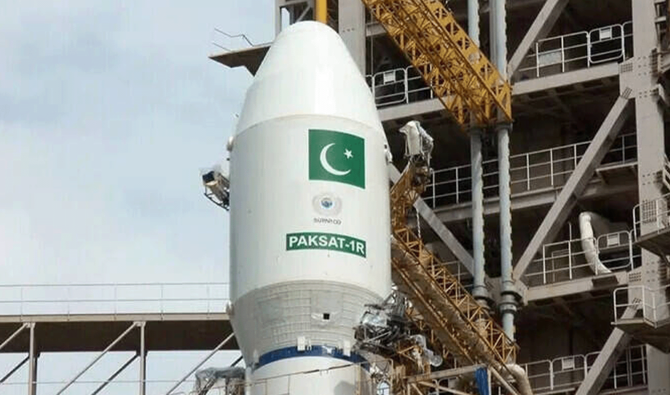
In a major leap for Pakistan’s space and climate-monitoring capabilities, the Space and Upper Atmosphere Research Commission (SUPARCO) announced the launch of the country’s first Hyperspectral Satellite (HS-1) from China’s Jiuquan Satellite Launch Centre on October 19.
According to SUPARCO, the HS-1 mission marks a transformative milestone in Pakistan’s national space programme, ushering in a new era of advanced space-based monitoring for agriculture, urban planning, disaster management, and environmental sustainability.
The hyperspectral satellite will capture hundreds of spectral bands across visible and infrared wavelengths, allowing scientists to detect subtle changes in soil, vegetation, water bodies, and infrastructure with exceptional accuracy. This data will be instrumental in enhancing crop yield estimates by 15–20%, improving irrigation efficiency, and strengthening food security nationwide.
SUPARCO said that HS-1’s cutting-edge sensors will also enable mapping of infrastructure, tracking of urban expansion, and identifying environmental degradation to support sustainable city planning and land-use management.
The agency highlighted that HS-1 will serve as a critical tool in disaster response and climate resilience, providing early warnings for floods and landslides, especially across northern Pakistan and the Karakoram Highway. The satellite’s real-time imaging capability will also help assess post-disaster damage, monitor deforestation, and manage water resources more efficiently.
The HS-1 mission aligns with SUPARCO’s Vision 2047 and the National Space Policy, which aim to position Pakistan at the forefront of space innovation for sustainable development. It will join the country’s expanding remote-sensing fleet, which includes PRSS-1 (2018), EO-1 (January 2025), and KS-1 (July 2025), significantly enhancing the nation’s Earth-observation capacity.
Officials say the launch further strengthens Pakistan-China cooperation in the civilian space sector, paving the way for advanced research, disaster preparedness, and agricultural innovation rooted in modern technology.
Related stories:
Pakistan-China Space Collaboration: Astronaut Training Begins